From Rigid Rules to Emotional Empathy 〰️ Reframing Flaws into Growth Mindsets 〰️ Subverting the "Good vs. Evil" Binary 〰️ Updating Community Ethics 〰️
From Rigid Rules to Emotional Empathy 〰️ Reframing Flaws into Growth Mindsets 〰️ Subverting the "Good vs. Evil" Binary 〰️ Updating Community Ethics 〰️
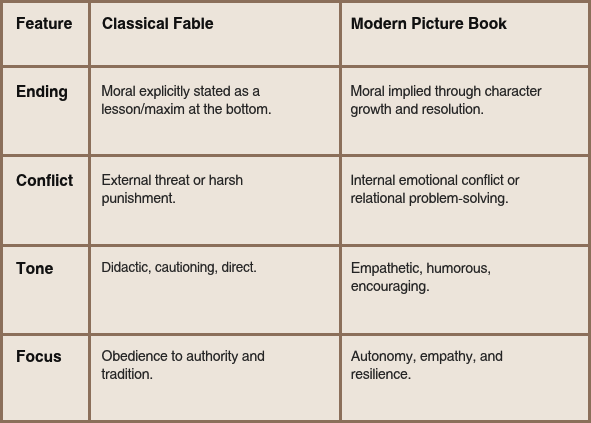
Picture book authors rarely preach or deliver explicit maxims like "Slow and steady wins the race." Instead, they adapt classical moral themes by reframing them through child-centered experiences, emotional nuance, and subverted expectations.
Our goal at ‘Unitmaster Reimagine’ is to recreate the classic tales with a modern approach focusing on the following.
1. From Rigid Rules to Emotional Empathy
Classical Approach: Punished characters who misbehaved (e.g., The Boy Who Cried Wolf ends with lost sheep or tragedy to enforce obedience).
Modern Adaptation: Explores why children make mistakes and focuses on restorative relationships and internal realization rather than fear.
2. Reframing Flaws into Growth Mindsets
Classical Approach: Fixed traits led directly to failure (e.g., the Hare's arrogance lost him the race; the Grasshopper was lazy).
Modern Adaptation: Emphasizes effort, learning from failure and personal development over static morality.
3. Subverting the "Good vs. Evil" Binary
Classical Approach: Clear villains and heroes (e.g., the Big Bad Wolf is irredeemable and meets a grim end).
Modern Adaptation: Adds perspective, humor and nuance challenging children to look beyond surface appearances or understand multiple viewpoints.
4. Updating Community Ethics
Classical Approach: Individual resource hoarders were punished or left to suffer (e.g., The Ant and the Grasshopper turning away the unprepared).
Modern Adaptation: Shifts from individualism to environmental stewardship and community care.
Key Structural Shift: Classical vs. Modern